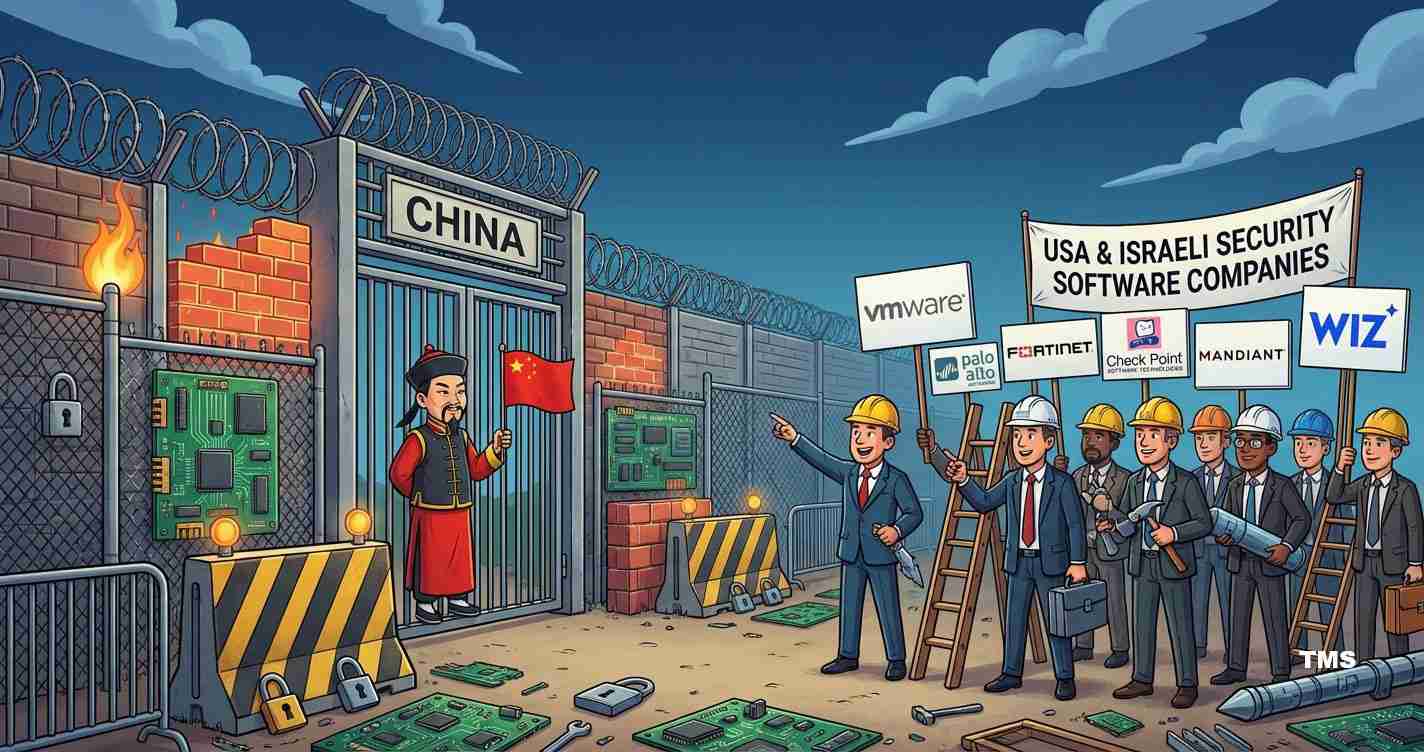
China bans US, Israeli cybersecurity tools: Beijing tells firms to stop using software from more than a dozen U.S. and Israeli companies
Beijing ordered domestic firms to stop using cybersecurity software from over a dozen U.S. and Israeli companies, citing national security fears that products could collect sensitive data and transmit it abroad, intensifying an ongoing tech rivalry.
Key takeaways
- Regulatory directive: Chinese regulators have reportedly told some domestic companies to suspend use of tools from more than a dozen overseas cybersecurity vendors, according to reporting by Fox Business, the Jerusalem Post and the Japan Times.
- Companies named: The list reportedly includes major vendors such as VMware (Broadcom), Palo Alto Networks, Fortinet, Mandiant, CrowdStrike, SentinelOne, Recorded Future, Wiz (Alphabet-owned), Rapid7, and Israeli firms like Check Point and CyberArk.
- Rationale: Beijing is said to worry the tools could collect confidential or operational data and send it overseas, a theme consistent with its broader tech-security and industrial policy priorities.
Main content
What was ordered and which companies are named
Sources told reporters that regulators instructed domestic firms to suspend use of software from a list of overseas cybersecurity vendors. The list reportedly includes U.S. companies such as VMware (now part of Broadcom), Palo Alto Networks, Fortinet, incident-response and threat-intel firms like Mandiant and Recorded Future, endpoint-security vendors including CrowdStrike and SentinelOne, and other vendors such as Rapid7, Wiz (Alphabet-owned) and Claroty. Israeli firms named include Check Point Software Technologies, CyberArk, Orca Security and Cato Networks. The security vendor Imperva, owned by France’s Thales, was also reported to be on the list.
Reporting noted that the Jerusalem Post first published details and highlighted that there was no public, regulator-issued list confirming the directive; see the article from the Jerusalem Post for more detail.
Why Beijing says the move is needed
Officials and analysts cited in reporting said Chinese authorities are concerned foreign-made cybersecurity tools that inspect network traffic or endpoints could become channels for confidential or operational data to leave the country or be exploited by foreign intelligence services. That concern has been a recurring justification in Beijing’s tech and security policies.
The directive also aligns with a broader push to replace foreign technology with domestic alternatives, as Beijing pressures local companies to reduce dependence on Western suppliers across semiconductors, cloud services, and now cybersecurity tools. Analysts frame the move as part of the broader U.S.–China competition over key technologies and sensitive data flows (see reporting by Fox Business and the Japan Times).
Broader context and related developments
The reports come at a sensitive moment in global tech politics: they follow diplomatic contacts such as a Chinese envoy’s visit to Israel and occur as the U.S. has adjusted export rules on advanced AI chips (including Nvidia’s H200 processors, with an announcement timed for publication on Jan. 15). Observers say such moves are interlinked with strategic competition over semiconductors, AI, and secure supply chains.
Chinese analysts have publicly raised concerns about Western-made equipment being vulnerable to hacking or espionage, offering political cover for decoupling steps. The reported ban functions both as a security measure and a political signal about limiting foreign influence in critical digital infrastructure (see analysis in the Japan Times).
Responses, gaps and verification
At the time of reporting, no Chinese regulator had issued a public notice naming the bans, the full list of affected domestic firms, or enforcement timelines. Major vendors named had not immediately issued public responses. Journalists covering the story emphasize the reporting relies on sources familiar with regulatory discussions rather than an official published list (see Jerusalem Post and Japan Times coverage).
“The practical effect — whether firms will be forced to remove software, switch vendors, or face procurement curbs — will depend on how regulators formalize the guidance and whether enforcement is broad or targeted.”
Security experts note the lack of clear timelines makes immediate operational impact uncertain for buyers that rely on these tools daily.
Implications for Sonoma, California
Local stakeholders in Sonoma should consider the reported directive’s potential ripple effects:
- Local businesses and IT buyers: Wineries, tourism operators, small manufacturers and professional services that use cloud and cybersecurity services supplied by major U.S. vendors may face heightened geopolitical risk when doing business with or hosting data in China. Businesses with China ties should review contracts, data flows and contingency plans.
- Cybersecurity vendors and MSPs: Sonoma’s managed service providers and local tech shops could see shifts in demand and vendor relationships if foreign suppliers lose market access in China. Diversifying toolsets and clarifying support arrangements will be important.
- Higher education and workforce: Regional programs and Sonoma State University may need to adapt curricula toward secure cloud engineering, supply-chain risk, and compliance to reflect shifting industry demand.
- Local economy and exports: Firms that sell software or data services internationally could encounter complications with partnerships or hosting agreements; insurers and financial institutions may reassess cyber risk and premiums.
- Practical steps: Inventory suppliers and tools, map data flows to/from China, ensure patching and multi-vendor strategies, maintain offline backups, and monitor federal guidance and vendor advisories.
Sources
Reporting and context drawn from: