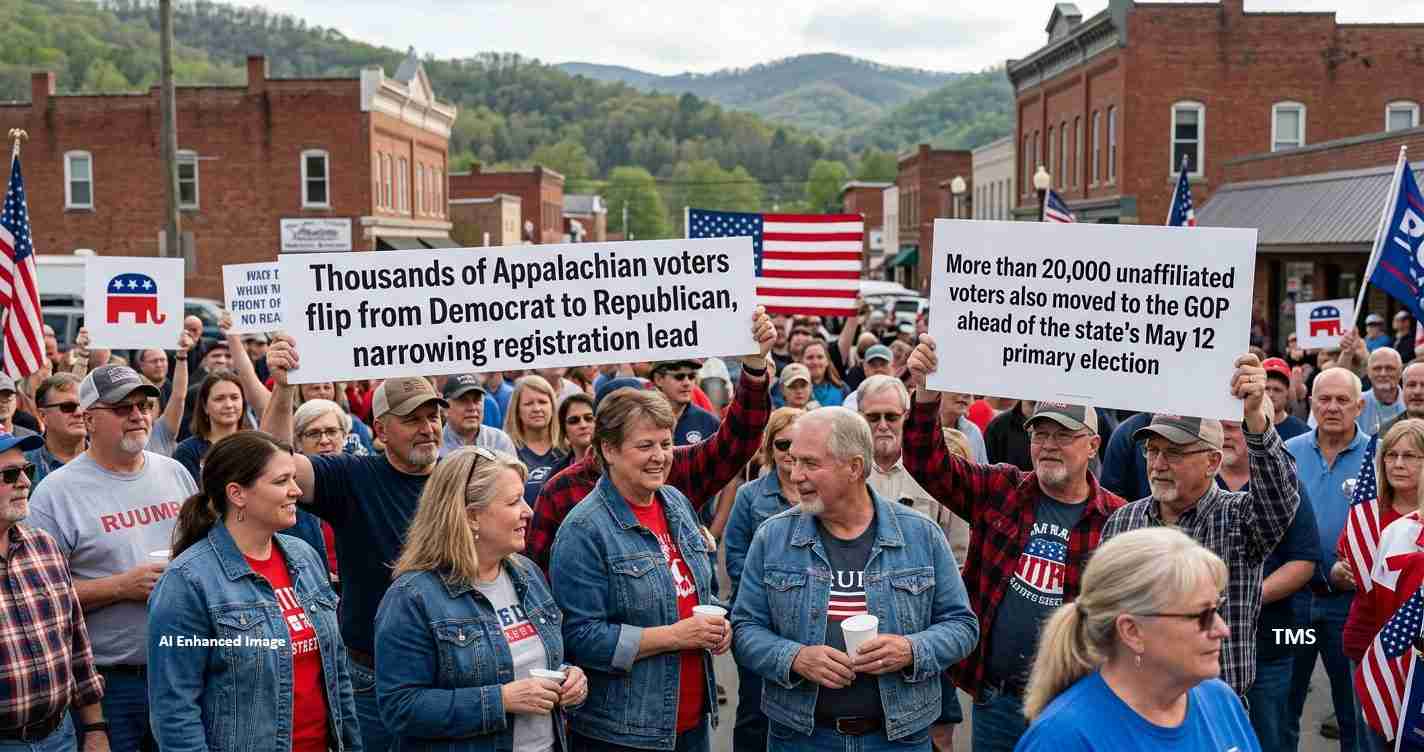
Over 68,000 West Virginians switched party affiliation since Jan. 31, 2024, state says
West Virginia (Sonoma Times) – Over 68,000 West Virginia voters changed party affiliation since Jan. 31, 2024, Secretary of State Kris Warner reports — with large flows into the Republican Party ahead of the May 12 closed primary and signs of broader political realignment statewide.
Key takeaways
- Total switches: 68,235 party changes reported since Jan. 31, 2024 — per Secretary of State data.
- Largest flows to GOP: 16,910 Democrats and 20,003 unaffiliated voters switched to Republican registration during the reporting window.
- Registration totals (April 23, 2024): Republicans 519,756; Democrats 327,089; Independents 301,933.
- Context: Closed-primary incentives produced short-term tactical moves; lawmakers later moved to extend candidate affiliation deadlines via House Bill 4710. See legislative coverage here.
What the data shows
The Secretary of State’s release documents a rapid pattern of party switching that accelerated in the weeks before West Virginia’s closed primary on May 12. The largest single flows favored the Republican Party: 16,910 Democrats and 20,003 unaffiliated voters moved into Republican registrations. At the same time, many voters left major parties to become unaffiliated — including 12,299 Democrats and 7,559 Republicans. Those movements produced a substantial net gain for the GOP during the reporting window.
The data summary released to the press is available from the Secretary of State data summary, which also notes that more than 1.19 million voters were eligible for the May 12 primary and that voter rolls were to be finalized after an April 28 deadline.
Why voters switched: closed primary incentives and other factors
State Republican leaders linked much of the surge to the mechanics of a closed primary. Del. Josh Holstein, chairman of the West Virginia Republican Party, told the Herald-Dispatch that many voters changed registration so they could participate in competitive GOP primaries restricted to registered party members. “This huge uptick in the last couple of months is certainly tied to the primary being closed,” Holstein said (reported in the Secretary of State coverage).
Democratic leaders emphasized a more complex pattern. Del. Mike Pushkin, chairman of the West Virginia Democratic Party, noted movements in multiple directions and cautioned against reading the numbers as a one-way exodus. The closed-primary incentive is a clear short-term driver: voters who want to influence a contested GOP primary have reason to register Republican just before the cutoff, producing large spikes in registration flows.
A longer-term picture: political realignment and history
The recent switching fits into a longer arc of West Virginia political realignment. The state has trended Republican at both state and federal levels in recent years, and high-profile personal switches have marked that shift — most notably Gov. Jim Justice’s party change in 2017. For background on that history, see reporting on Gov. Justice’s switch at ABC News.
Lawmakers in Charleston responded to tactical affiliation changes: in February 2026 the West Virginia House passed House Bill 4710, extending candidate affiliation requirements from 60 days to 180 days before filing, adding electronic verification and creating a complaint process intended to discourage last-minute tactical switches. That change takes effect Jan. 1, 2027. Read the bill coverage here.
Closer look at the numbers
Summing flows that favored the GOP — Democratic-to-Republican (16,910) plus unaffiliated-to-Republican (20,003) — yields 36,913 registrations into the Republican column. Offsetting flows away from the GOP (Republican-to-unaffiliated 7,559 and Republican-to-Democrat 2,399) total 9,958. That arithmetic produces a sizable net pickup for Republican registrations during the period reported.
State totals as of April 23 show Republicans with 519,756 registrants versus 327,089 Democrats and 301,933 independents. However, Democrats plus independents still outnumber Republicans by roughly 110,000 — a reminder that registration totals do not map perfectly onto turnout or election outcomes.
Implications for Sonoma, California
West Virginia’s registration shifts may have indirect effects and lessons for Sonoma residents and local parties:
- National campaigning and attention: As Republican gains in West Virginia become notable, national GOP organizations may redirect resources to Appalachian and rural regions — potentially changing where political advertising and digital outreach originate. Keyword relevance: Republican gains West Virginia. See the state data here.
- Lessons for local parties: Sonoma activists can study how primary rules shape behavior. West Virginia’s closed primary encouraged tactical registration changes; California’s top-two system differs, but the broader lesson holds: primary design affects strategy and turnout.
- Voter registration and turnout strategy: Policy changes like HB4710 can affect when and how people register. Local groups should adapt outreach timing and messaging to local rules to avoid unintended consequences. Legislative coverage is available here.
- Media and public discourse: Registration jumps can be volatile; turnout, candidate quality and local issues ultimately shape elections. The back-and-forth movement — including Democrats and Republicans moving to unaffiliated — highlights volatility rather than simple partisan collapse.
- Social and cultural parallels: While Sonoma and West Virginia differ demographically, both regions show how local economies, cultural issues and national narratives can shape political identity.
Reporting notes and sources
This article is based on registration data and reporting from the West Virginia Secretary of State’s office, coverage in the Herald-Dispatch and Sonoma Times, and legislative reporting from regional outlets. Primary sources:
- Secretary of State data summary and Sonoma Times coverage — includes totals and the breakdown of party flows.
- House Bill 4710 coverage — reporting on the change to candidate affiliation deadlines.
- Historical reporting on Gov. Jim Justice’s party switch.
Direct quotes from party officials were reported to the Herald-Dispatch and cited in the Secretary of State data release. Reporting on these registration trends continues as West Virginia finalizes its rolls and as lawmakers respond with new rules intended to reduce last-minute tactical switches.