Astronomers Witness Magnetar Birth in Superluminous Supernova SN 2024afav; General Relativity “Chirp” Confirms 16-Year UC Berkeley Theory
UC Berkeley researchers and collaborators directly observed a newborn magnetar powering superluminous supernova SN 2024afav, and detected a rising-frequency “chirp” in its light curve that matches predictions from Einstein’s general relativity. Published in Nature on March 11, 2026.
Key takeaways
- Object: superluminous supernova SN 2024afav, discovered December 2024, ~one billion light-years away.
- Discovery: first direct observation of a newborn magnetar powering an SLSN-I with a measurable relativistic “chirp.”
- Measurements: estimated initial spin ~4.2 milliseconds and magnetic field ~300 trillion times Earth’s field (UC Berkeley College of Letters & Science).
Key information
Object observed: the superluminous supernova SN 2024afav, discovered in December 2024 at roughly one billion light-years distance.
Discovery: the first direct observation of a newborn magnetar powering an SLSN-I, producing a measurable “chirp” in the light curve linked to general relativity.
Key measurements: teams estimate an initial spin of ~4.2 milliseconds and a magnetic field roughly 300 trillion times stronger than Earth’s, as described in the UC Berkeley summary (College of Letters & Science release).
Theory validated: the finding vindicates a model first proposed in 2010 by UC Berkeley physicist Dan Kasen and similar proposals by other theorists, as summarized by the UC Berkeley news release (news release).
How astronomers caught a magnetar being born
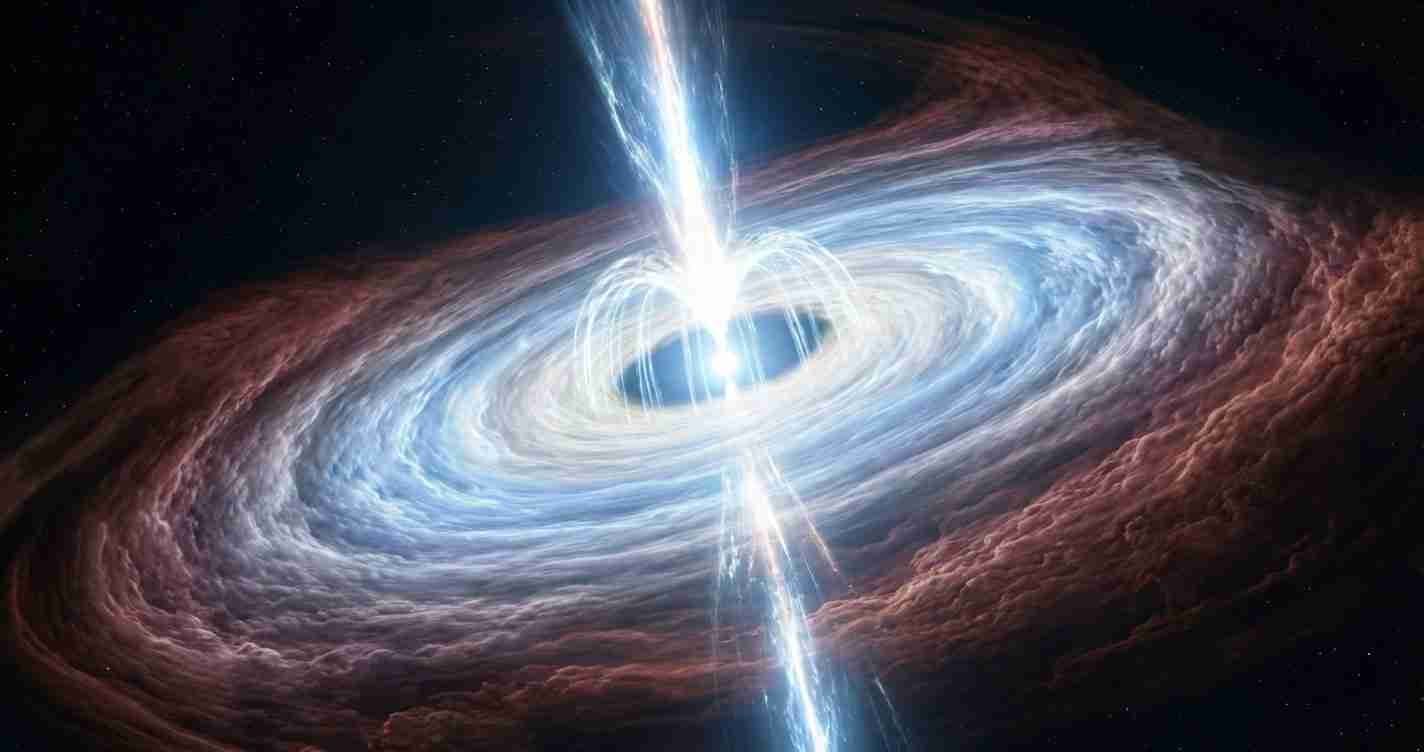
SN 2024afav was first detected in late 2024. Observing teams worldwide tracked its brightness over months. Graduate student Joseph Farah led an analysis of the light curve and identified periodic “bumps” within the overall fading glow. Those bumps form a rising-frequency pattern — a distinct chirp — that matches models for a young magnetar losing energy as it slows under general relativity (LS release; UC Berkeley news).
Farah estimated the newborn neutron star spun about once every 4.2 milliseconds at birth and carried a magnetar-class field — hundreds of trillions of times stronger than Earth’s. As the magnetar slows, its magnetic field accelerates charged particles into the expanding debris, heating the ejecta and sustaining brightness much longer than ordinary supernova models predict (LS release).
The “chirp” and general relativity
The light-curve modulation is not random flicker; it is a clear, rising-frequency modulation tied to relativistic spin-down — the predicted change in a magnetar’s rotation when strong gravity and high rotational speeds interact under Einstein’s equations. Co-authors and peer reviewers described the feature as a smoking gun linking newborn magnetar physics to observable light.
“To see a clear effect of Einstein’s general theory of relativity is always exciting, but seeing it for the first time in a supernova is especially rewarding.” — Alex Filippenko, UC Berkeley astronomy professor and co-author.
How this confirms a long-standing theory
In 2010 Dan Kasen proposed that magnetars could power superluminous supernovae by injecting rotational energy into the explosion. The observations of SN 2024afav provide direct evidence that a magnetar’s spin and magnetic field can sustain an SLSN’s prolonged and extreme luminosity, validating Kasen’s model and similar proposals by other theorists such as Stanford’s Woosley (UC Berkeley news).
Who was involved and where the work appears
The discovery team includes researchers at UC Berkeley, Las Cumbres Observatory, UC Santa Barbara, the Flatiron Institute and other institutions. Key contributors named in the paper include Joseph Farah, Logan Prust, Yuan Qi Ni and D. Andrew Howell. Funding acknowledgments cite private donors and institutional sources, including support from contributors such as Christopher R. Redlich. The study appears in Nature on March 11, 2026, with summaries on UC Berkeley sites and major science outlets (LS release; UC Berkeley news).
What is a magnetar — and why scientists care
A magnetar is a type of neutron star: an extremely dense, roughly 10-mile-wide remnant left when a very massive star collapses. Magnetars host magnetic fields far stronger than ordinary neutron stars and can spin hundreds to thousands of times per second when young. That rapid spin plus intense magnetism powers emissions and impacts surrounding material. Scientists link magnetars to other cosmic mysteries, including fast radio bursts; observing one form inside a supernova provides a template to find and study more.
Expert reactions
Reaction across the astronomy community was immediate. Joseph Farah called the work “the most exciting thing I have ever had the privilege to be a part of… It’s the universe telling us out loud and in our face that we don’t fully understand it yet.”
D. Andrew Howell (Las Cumbres Observatory & UC Santa Barbara) said, “Joseph has found the smoking gun… explained everything with the best-tested theory in astrophysics—general relativity.” (UC Berkeley news; LS release).
What comes next for researchers
Teams will comb archival and new supernova datasets to search for similar chirps. Finding more events will refine magnetar-formation models, measure the distribution of spins and fields, and test whether magnetars can explain most SLSNe. The chirp may also become a new marker to identify newborn magnetars that later produce fast radio bursts (Smithsonian Magazine).
Implications for Sonoma, California
Economic impact: Sonoma County and the North Bay benefit from being part of the Bay Area science ecosystem. UC Berkeley’s headline discoveries can attract research grants, philanthropic gifts and private investment to local science centers, supporting jobs at nearby labs, observatories and tech firms that partner with astronomers (UC Berkeley news).
Political consequences: Local and regional leaders who back science funding can point to this discovery as proof that public and private research support yields global impact, potentially prompting modest increases in county or state backing for STEM education and public science programs (LS release).
Social and cultural effects: The find supplies classrooms and community groups with a compelling story to spark interest in physics and astronomy. Local museums, planetaria and public programs are likely to reference the magnetar birth and the striking general-relativity chirp, enriching regional science outreach (Smithsonian).
Practical applications for residents: While basic science, the discovery supports education, tourism and workforce development—expect more public science events from UC Berkeley extension programs and internships for high-school students interested in physics tied to Bay Area observatories and labs (UC Berkeley news).
Where to read more and follow the science
Primary team summaries and quotes are posted on UC Berkeley’s sites and in the Nature paper (March 11, 2026). Additional accessible coverage includes:
- UC Berkeley news release
- UC Berkeley College of Letters & Science summary
- Smithsonian Magazine coverage
- Popular Science summary
- Perplexity summary
- National Today coverage
- Science/News blog summary
Scientists say SN 2024afav and its general relativity chirp provide a clear new observational marker to find and study newborn magnetars. For Sonoma residents following Bay Area science and education, the discovery ties local institutions to a rare, universe-scale event and may bring new learning and funding opportunities to the region (LS release).