Scientists solve how Easter Island’s Moai “walked,” new study backs Rapa Nui oral traditions
New research in the Journal of Archaeological Science shows Easter Island’s Moai were transported upright by a rocking “walking” motion, resolving a centuries‑old mystery and validating Rapa Nui oral traditions about the statues’ movement and engineering ingenuity.
- Design enabled movement: The Moai’s wide, D‑shaped bases and subtle forward lean made upright, rocking “walking” possible — a finding reported by Local12 and summarized in Popular Mechanics.
- Practical, low‑resource method: Experiments, models and physics show teams of roughly 15–18 people could move statues upright using long ropes, requiring far less wood and labor than sled or roller theories (Live Science, Local12).
- Oral tradition confirmed: Statistical mapping and fieldwork on nearly 1,000 statues align with Rapa Nui stories that the Moai “walked” to their ahu (ScienceDaily).
Main story and methods
How the study was done
Researchers combined computer modeling, lab tests and field experiments to test upright transport. Teams scanned statues across Rapa Nui and built 3D models to study shapes and centers of mass. Those scans revealed most Moai have a broad base and forward tilt that allow rocking without toppling.
Physics simulations quantified the energy and mechanics of alternating rocking steps. Finally, archaeologists tested the concept with a 4.35‑ton replica, ropes and human teams to measure how the method worked in practice — details reported in Live Science, the University of Arizona write‑up (University of Arizona) and the study’s working paper (SSRN).
The mechanics: pendulum dynamics and design
Key physical insight: the Moai’s low center of mass and tapered forward lean create pendulum‑like dynamics. Once tipped slightly and pulled with ropes, gravity helps swing the statue back and forth; that swing becomes a steady, low‑energy rhythm. In physics terms, after motion begins the incremental energy needed to sustain movement drops, so a relatively small group can keep a large statue moving over long distances (Live Science; University of Arizona).
“The statues’ shapes produce a natural rocking motion — not random tipping — that skilled teams could control with ropes.”
Field experiments and numbers
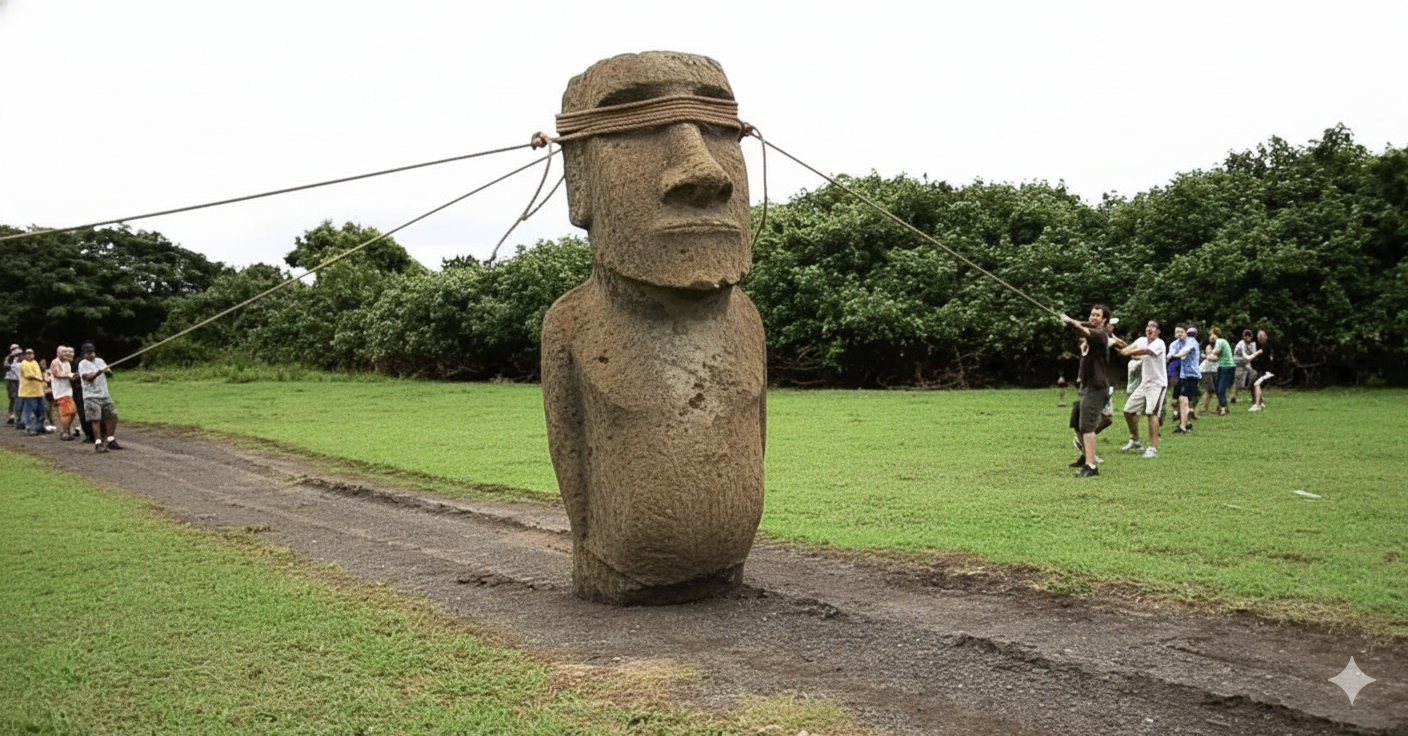
Field tests with a 4.35‑ton replica showed teams could move a statue upright by alternately pulling ropes attached to each side. The tested crew of roughly 15–18 people covered 328 feet (100 meters) in 40 minutes in one trial, implying a potential rate near 1,000 feet (310 meters) per hour under good conditions — enough to move statues several miles in days rather than weeks (Local12; Live Science).
Why this changes the story about Easter Island
Earlier theories emphasized wooden sledges or rollers and suggested large‑scale deforestation. This walking model requires only ropes and coordinated human effort, dramatically lowering estimated wood use and labor. The result reframes the Rapa Nui as ingenious engineers rather than victims of ecological self‑destruction (Local12; Popular Mechanics).
Alignment with Rapa Nui oral traditions
Rapa Nui elders long told that the Moai “walked” to their ahu. This work does more than suggest metaphor — it provides a plausible, repeatable engineering technique that matches oral memory. Scientists inspecting roads, abandoned statues and cultural records report the evidence aligns with stories passed down by Rapa Nui communities (ScienceDaily).
What other experts say
Independent archaeologists and physicists praised the clear experiments and the study’s integration of indigenous knowledge with modern analysis. Peer reviewers noted the clever use of experiments and modeling, and some external scientists highlighted how archaeology can work with — not against — local histories (Live Science; SSRN).
Implications for Sonoma, California
Economic: This renewed interest in the Moai could inspire themed exhibits, lectures and travel interest that draw visitors to Sonoma — benefiting museums, hotels and tour operators.
Political: Local leaders might fund special exhibits or educational exchanges; research can justify grants that highlight global indigenous engineering and sustainable tourism.
Social & cultural: Schools and cultural organizations can use the discovery to teach how scientific methods and oral history can converge. Community events, pop‑up physics demos and respectful exhibits could foster dialogue between Sonoma groups and indigenous partners.
Practical ideas for residents: hands‑on rocking‑motion demos, a pop‑up Moai mechanics exhibit, or joint lecture series with universities and museums.
Resources and links for further reading
- Local12 coverage
- Popular Mechanics
- Fox News travel write‑up
- Live Science analysis
- University of Arizona experts’ publication
- ScienceDaily release
- SSRN working paper
Reporting for this story reviewed the Journal of Archaeological Science findings as reported by multiple outlets and the study’s supplemental materials. The research sheds new light on how Moai were moved and why Rapa Nui oral traditions long said the statues walked — a narrative now supported by experiments, physics and close archaeological study.