Skip to content

Business and FinanceCalifornia5 min read

Robotaxi Glitch Leaves California Traveler Without Luggage at San José Airport

A California traveler’s airport trip took an unexpected turn when a driverless Waymo vehicle reportedly left with his luggage still locked in the trunk after a failed release attempt. The incident comes as autonomous ride-hailing services continue expanding across major California cities and airports, raising broader questions about customer service, accountability and public confidence in robotaxi technology.

Share

Topics

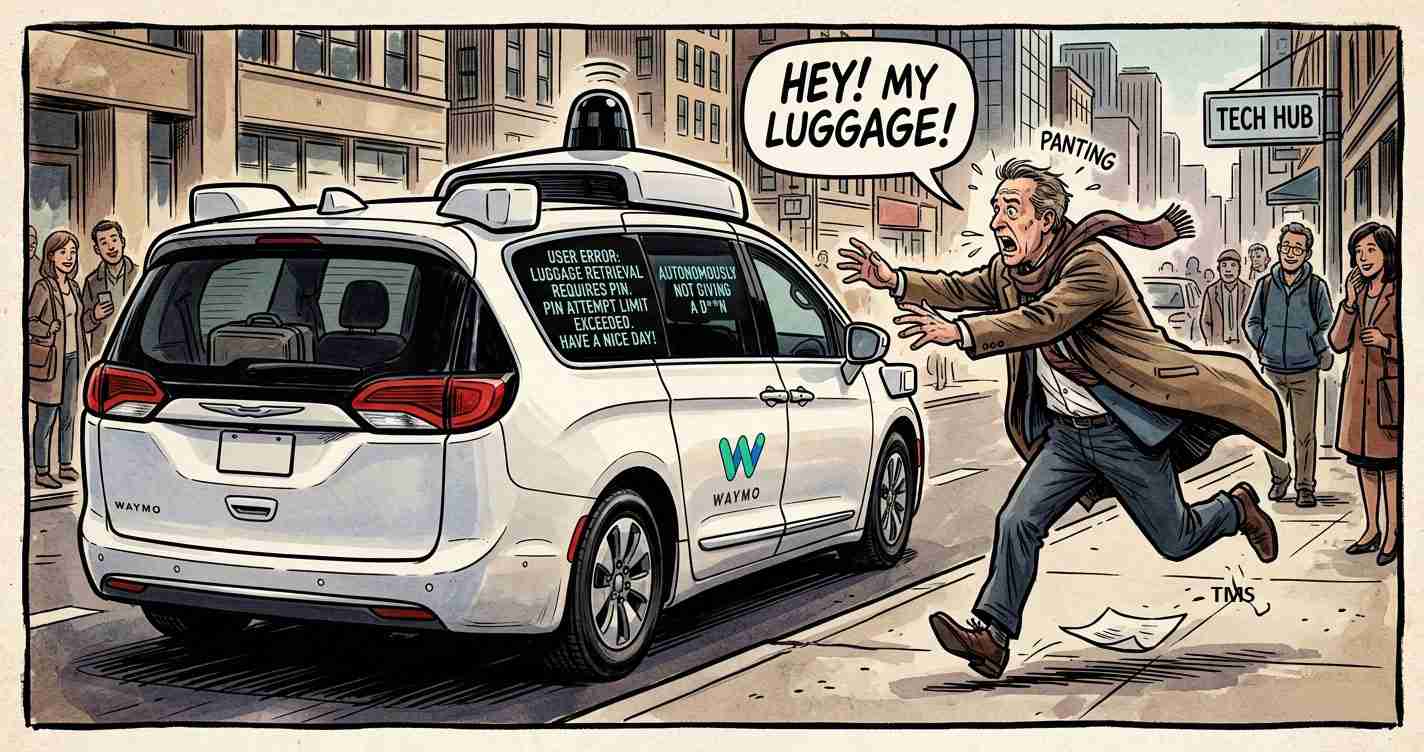
Cartoon of a self-driving Waymo taxi on a city street, a man chasing it and shouting "Hey! My luggage!" as papers flutter behind him.
Waymo Car Not Releasing the Luggage From The Trunk (Image Staff)

As Driverless Airport Rides Expand Across California, One Passenger’s Lost Suitcase Raises Questions About Customer Support and Reliability

San Jose, California (Sonoma Times) – A routine airport trip in a driverless taxi turned into a stressful ordeal for a California business traveler after a self-driving Waymo vehicle reportedly drove away with his suitcase still locked inside the trunk at San José Mineta International Airport. The incident, which quickly gained attention online, highlights growing public concerns about how autonomous ride-hailing companies handle everyday travel problems when no human driver is present to intervene.

Top Areas This Article Covers

  • Expansion of autonomous airport transportation in California
  • The reported Waymo luggage incident at San José Mineta International Airport
  • How robotaxi customer support systems respond during service failures
  • The history and growth of autonomous vehicle technology
  • Public trust and safety concerns surrounding driverless transportation
  • Travel tips for passengers using autonomous ride-hailing services

A traveler identified as Di Jin reportedly booked a Waymo ride from Sunnyvale to San José Mineta International Airport ahead of a business trip. According to reports surrounding the incident, the autonomous ride itself proceeded normally until the vehicle reached the airport drop-off area. Problems began when the passenger attempted to retrieve his luggage from the trunk.

The trunk allegedly failed to open despite repeated attempts using the release controls. Moments later, the vehicle reportedly departed the curbside area with the passenger’s suitcase still inside. The traveler was left at the airport without clothing, work materials or personal belongings needed for the trip.

The situation underscores a unique challenge in autonomous transportation. In a traditional rideshare encounter, passengers can communicate directly with a driver during unexpected problems. With a fully autonomous vehicle, riders instead rely on software controls, mobile applications and remote support representatives. When technology fails in a time-sensitive setting such as an airport, even a relatively small issue can escalate quickly.

According to reports, the passenger immediately contacted Waymo support after the vehicle left the airport. The company allegedly informed him that the car had already been routed toward a depot facility and could not be recalled. The luggage was later located at a Waymo facility, but discussions reportedly followed regarding the cost and logistics of returning the suitcase to its owner.

The incident has attracted attention partly because Waymo’s published policies state that riders can open trunks either through the mobile application or by using an exterior release button. Company guidance also notes that trunks may not open if passengers exit before the vehicle has fully completed the trip sequence.

The company’s lost-and-found policy additionally states that while support teams attempt to reunite riders with forgotten items, Waymo cannot guarantee immediate recovery or reimbursement for belongings left behind. In this case, however, the passenger reportedly maintained that the bag was not forgotten but became inaccessible because the trunk failed to release before the vehicle departed.

California’s Growing Robotaxi Expansion

The episode arrives during a major expansion phase for autonomous transportation in California and several other states. San José Mineta International Airport became the first commercial international airport in California to officially support fully autonomous ride-hailing operations in late 2025, marking a milestone for the self-driving vehicle industry.

Waymo, owned by Alphabet Inc., traces its origins back to Google’s self-driving car project launched in 2009. Over the past decade, the company has tested autonomous vehicles across Arizona, California and Texas while competing alongside companies such as Tesla, Cruise and Zoox.

Phoenix became one of the first large-scale testing grounds for fully driverless public rides, and California later emerged as a major battleground for autonomous vehicle expansion. Regulators with the California Public Utilities Commission and the Department of Motor Vehicles gradually approved broader testing and commercial service operations as companies logged millions of autonomous driving miles.

Supporters of autonomous vehicles argue the technology could eventually reduce traffic accidents caused by human error, improve mobility for elderly and disabled passengers and reshape urban transportation systems. Critics, however, continue to raise concerns about safety, software failures, emergency response coordination and the ability of companies to manage unusual real-world situations.

Public Trust Remains a Critical Challenge

Transportation analysts have long noted that public confidence may become just as important as the technology itself. Even isolated incidents can influence how consumers perceive autonomous systems, especially when airport travel and personal belongings are involved.

Airport rides remain one of the most stressful parts of travel because passengers often face strict boarding times, heavy luggage and limited flexibility. A delayed bag retrieval can potentially result in missed flights, business disruptions and expensive replacement purchases.

Industry observers say customer support systems may become increasingly important as robotaxi services scale nationwide. Unlike traditional rideshare services, autonomous transportation removes direct human interaction from many situations, placing greater pressure on software systems and remote support teams to resolve problems quickly.

Advice for Travelers Using Autonomous Ride Services

As driverless transportation becomes more common, travelers are being encouraged to take additional precautions when using autonomous airport rides. Experts recommend keeping passports, medications, laptops, chargers and important documents inside the passenger cabin rather than storing them in the trunk. Travelers are also advised to confirm trunk access before fully exiting the vehicle and to keep rideshare applications open during the drop-off process.

While autonomous ride-hailing continues gaining acceptance across major cities, the recent luggage incident serves as a reminder that even advanced transportation systems still face ordinary human challenges. For companies hoping to normalize driverless travel, how they respond when technology fails may ultimately matter as much as how well the vehicles drive themselves.

Share

Topics

Andrew Brexton

Andrew Brexton is a senior technology analyst for Times Media Service, based in the Washington bureau. Brexton covers technology, artificial intelligence and emerging innovations, as well as energy, explaining complex technical developments for general readers. Brexton holds a master's degree in electrical and computer engineering and grew up in Galloway, Ohio.

Write to Andrew