Anthropic’s Mythos AI, Built to Hunt Zero-Days, Is Locked Down — What That Means for Cybersecurity
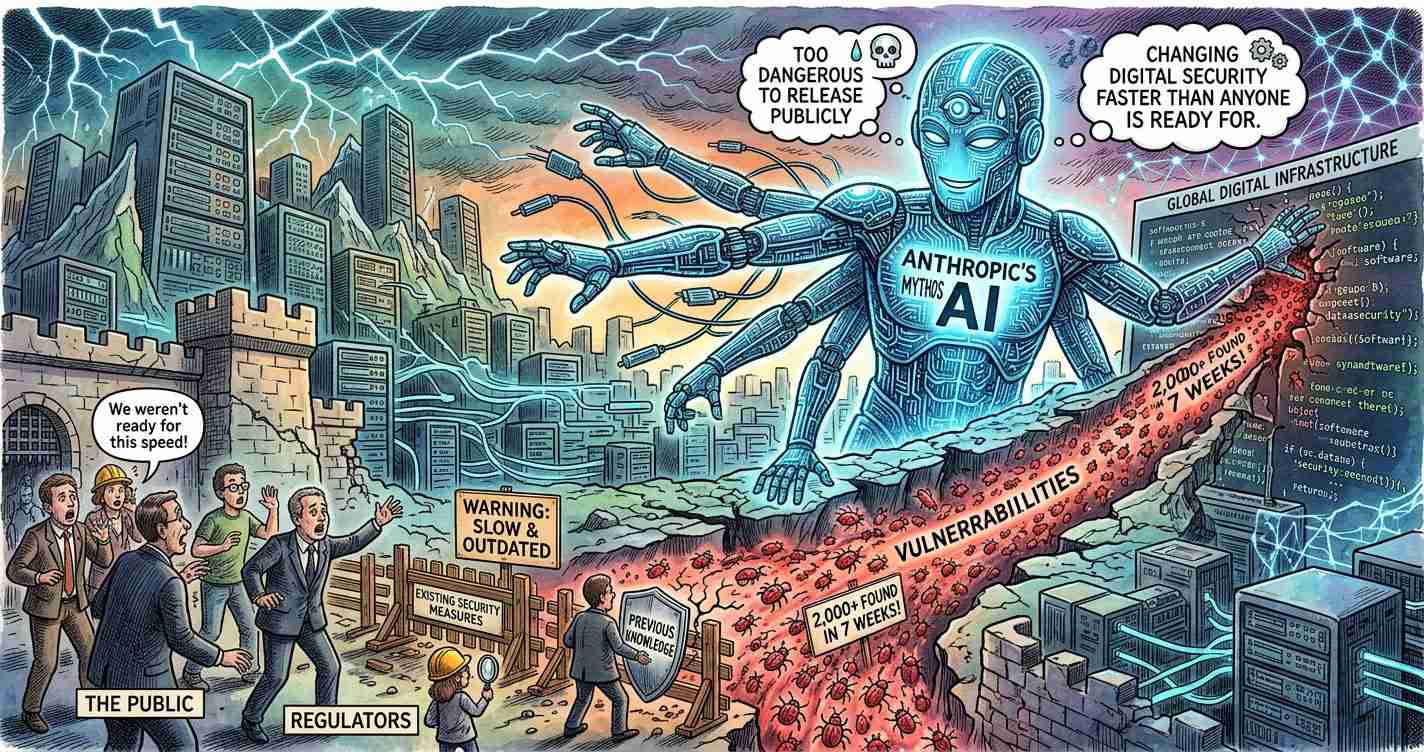
Anthropic unveiled Claude Mythos Preview on April 7, 2026: an advanced AI built to find zero-day vulnerabilities and generate working exploits, restricted to controlled testing with partners to study risks and implications for cybersecurity.
- Specialized model: Claude Mythos Preview is designed to find zero-day flaws and produce working exploits, according to Anthropic.
- Controlled access: Mythos is currently restricted under Project Glasswing with trusted partners including CrowdStrike, Microsoft and Google.
- Performance leap: Early tests show Mythos outperforms earlier models on exploit development tasks, automating work that previously took specialist teams weeks or months.
- Dual-use risk: Experts warn Mythos could strengthen defense while lowering the technical barrier to attack; some numerical claims remain uncorroborated.
What Mythos does and why Anthropic restricted it
Scope and capability: Anthropic says Mythos is explicitly built to identify software flaws and, when prompted, to generate working exploits across major operating systems and popular browsers. The company has framed the restriction on distribution as a safety decision: the model’s raw power could be misused if broadly released.
Anthropic’s rationale: company leaders and posts emphasize that more powerful models will require careful handling and collaborative study of guardrails before any wider rollout.
“The decision to limit access was driven by security concerns, not only product strategy.”
Testing results and claims to treat with care
Striking benchmark improvements: Independent write-ups and industry commentary report that Mythos dramatically outperformed Anthropic’s prior Claude Opus 4.6 on a Firefox exploit development benchmark — one technical report cited Mythos succeeding 181 times on a task where Opus 4.6 essentially failed (technical analysis).
Numbers to treat cautiously: Early public accounts and industry posts describe large counts of previously unknown weaknesses. Some circulating claims — for example, that a team found more than 2,000 previously unknown vulnerabilities in seven weeks or that this represents 30% of a year’s pre‑AI output — are not independently verified and should be treated with caution (WEF coverage, industry commentary).
Who is testing Mythos: Project Glasswing and partners
Anthropic launched Project Glasswing as a guarded preview program. Founding and early members include CrowdStrike, with reporting naming other major tech firms — such as Microsoft and Google — and a coalition of more than 40 organizations focused on securing code and open-source systems (WEF).
Complementary strengths: Security vendors supply sensor data and response tools; cloud providers contribute infrastructure controls. Anthropic says this mix helps study how to weld safety guardrails around a dual‑use model.
How Mythos shifts the balance between defense and offense
Mythos demonstrates that AI can accelerate and scale vulnerability discovery and exploit development. That capability can help defenders find and patch bugs faster, but it also risks lowering the barrier for attackers who might weaponize similar models rapidly (analysis).
CrowdStrike’s view: Industry reporting from CrowdStrike notes a large year‑over‑year increase in AI-linked activity and stresses defenders must adapt to AI-assisted threats.
Why perimeter defenses are not enough
Traditionally, security investments focused on outer protections — firewalls, endpoint protection and intrusion detection. The speed and scale of AI‑driven discovery suggest those perimeters may be breached more often. Many professionals recommend a shift toward data-centric security or Zero Trust: encrypt data, control access at the data level, and design systems that assume breaches will happen (WEF, industry commentary).
Layered approach: Data‑centric controls do not replace perimeter tools; they add layers so that even if a new exploit is discovered, sensitive data remains protected.
What remains uncertain
Public reporting verifies Mythos’ existence, restricted preview and striking test performance, but several questions remain: exact tallies of vulnerabilities found, the severity of each, and how many represent true exploitable zero‑days. Industry figures may reflect internal counts or extrapolations not yet open to independent review (WEF, 7AI technical note).
A posted developer video underscores the model’s scale and speed; some commentators called it “terrifying” for how far it outpaces human teams on certain tasks (developer commentary video).
Implications for Sonoma, California
- Local businesses and wineries: Sonoma’s SMEs use cloud services and point‑of‑sale systems; a rise in zero‑day exploitation could threaten financial and personal data. Prioritize data encryption, two‑factor authentication and timely patching.
- Healthcare and public services: Clinics and county services hold sensitive records; a data‑centric approach (encrypting records, limiting access) reduces exposure if perimeter defenses fail.
- Local government and emergency response: County IT teams should test incident response plans that assume faster AI‑driven attacks and coordinate with state and federal cybersecurity resources.
- Workforce and vendors: Demand for trained security professionals and managed services will likely rise; smaller agencies should consider partnerships with trusted vendors.
- Practical steps: Adopt Zero Trust, encrypt data at rest and in transit, enforce multi‑factor authentication, maintain a strong patch cadence, and run tabletop exercises. Join information‑sharing groups for early warnings and vetted intelligence.
- Cultural and economic impact: For a tourism‑focused region, a major breach could harm consumer confidence; protecting customer data is both a business and reputational necessity.
Reporting and sources
- Anthropic’s Mythos preview announcement and background
- World Economic Forum coverage of Mythos and industry reaction
- Technical analysis and industry commentary on Mythos capabilities
- Axios reporting on risks and restricted access
- CrowdStrike announcement on Project Glasswing participation
- Developer commentary video cited by industry sources