Federal appeals court ends SAVE plan, forcing millions to weigh new student loan repayment options as federal student loan changes 2026 take effect
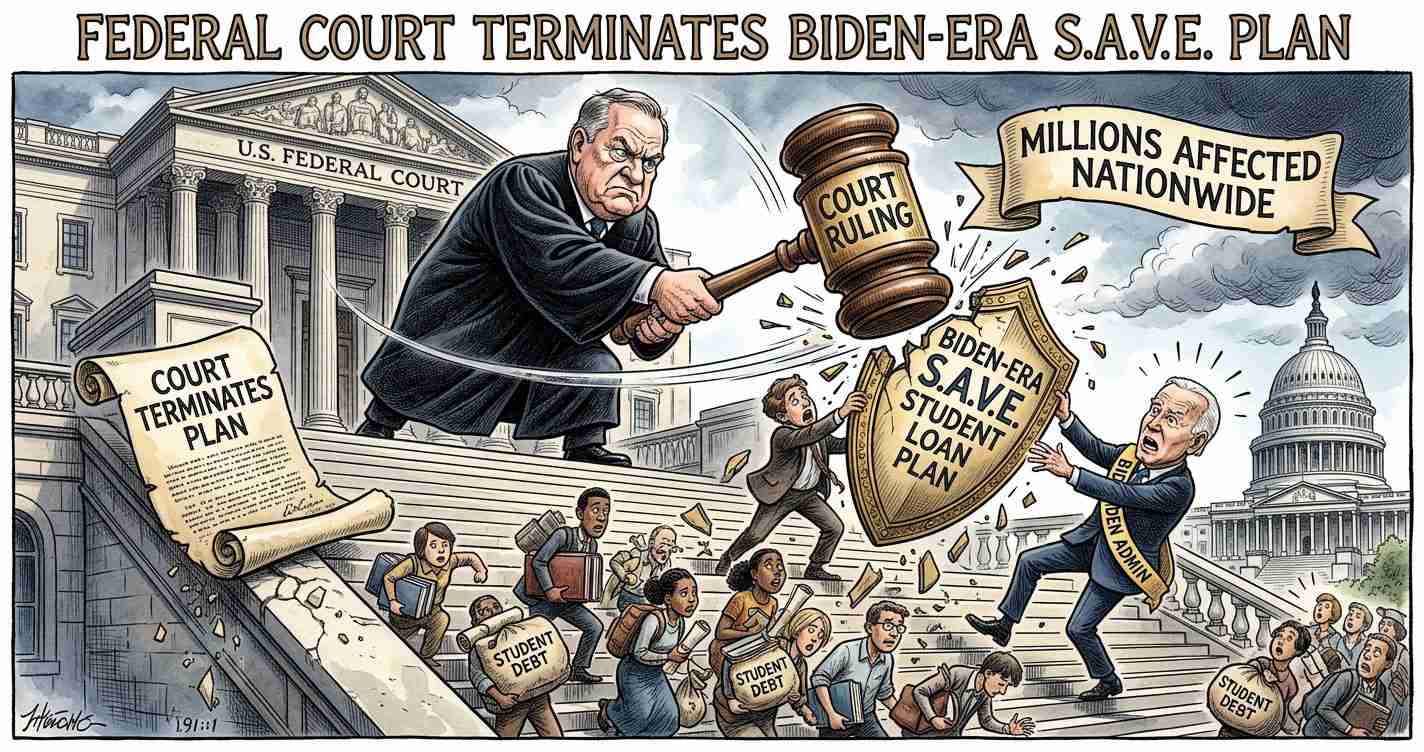
The U.S. Court of Appeals for the 8th Circuit officially terminated the Biden-era Saving on a Valuable Education (SAVE) plan on March 9, 2026, forcing over 7 million federal student loan borrowers to seek new repayment routes as the Department of Education transitions enrollees toward compliant alternatives including the Repayment Assistance Plan (RAP).
Key takeaways
- SAVE legally ended: The 8th Circuit reversed a dismissal and ordered the Department to stop enrollments and deny pending applications, per the U.S. Department of Education statement.
- Millions affected: More than 7 million borrowers were enrolled and roughly 450,000 had pending applications; other estimates place the total impacted near 7.6 million (The College Investor coverage).
- New options coming: The Repayment Assistance Plan (RAP) launches July 1, 2026, while existing incomes-driven plans and consolidation rules shift under the 2025 OBBBA changes (TCNJ Financial Aid overview).
SAVE Plan officially ended — what the 8th Circuit ruling means
What happened: On March 9, 2026, the U.S. Court of Appeals for the 8th Circuit reversed a lower-court dismissal and finalized the termination of the Biden administration’s SAVE plan, an income-driven repayment program that subsidized unpaid interest and often produced very low monthly payments—sometimes $0—according to the U.S. Department of Education statement.
Scope: More than 7 million borrowers were enrolled in SAVE, with about 450,000 pending applications, per the Department; other tallies estimate roughly 7.6 million people had received SAVE benefits (The College Investor coverage).
The ruling requires the Department to stop new enrollments, deny pending applications, and transfer current enrollees into legally compliant repayment plans under a December 2025 settlement with Missouri (U.S. Department of Education statement).
Background: legal fight and timeline
Launch and features: The SAVE plan began in 2023 and was touted as “the most affordable repayment plan ever created,” primarily because a subsidy prevented unpaid monthly interest from increasing borrower balances (U.S. Department of Education statement).
Legal challenges: Republican-led states argued the Education Department exceeded its authority. A February 2025 injunction from the 8th Circuit earlier blocked the 0% interest benefit; the 8th Circuit’s March 9, 2026 decision overturned a district judge’s dismissal and further cemented the plan’s end (U.S. Department of Education statement; The College Investor coverage).
The December 2025 settlement mandates negotiated rulemaking to remove SAVE from federal regulations while retaining narrow protections—such as recognizing forbearance or deferment credit for IDR forgiveness accounting (U.S. Department of Education statement).
Student loan repayment options now — what to consider
Borrowers must evaluate alternatives that match income, repayment horizon and forgiveness goals. Below are the primary federal options and practical considerations:
Income-Based Repayment (IBR)
IBR remains available for loans disbursed before July 1, 2026. It typically sets payments at about 10%–15% of discretionary income with forgiveness after 20–25 years depending on loan type and borrower history (TCNJ Financial Aid overview).
Repayment Assistance Plan (RAP)
Effective July 1, 2026: RAP, enacted in the 2025 One Big Beautiful Bill Act (OBBBA), bases payments on a sliding scale tied to Adjusted Gross Income (AGI): roughly 1%–10% of AGI with a $10 monthly floor for very low AGI. Forgiveness under RAP requires 30 years of payments, and RAP will be the primary IDR option for loans taken out on or after July 1, 2026 (TCNJ Financial Aid overview; U.S. Department of Education statement).
Standard, graduated and extended plans
Borrowers should also consider fixed-payment plans: the standard plan (usually 10 years), graduated plans, and extended plans that can stretch repayment up to 25 years for larger balances (TCNJ Financial Aid overview).
Practical steps recommended
- Use the Federal Student Aid Loan Simulator to compare options and estimate payments.
- Watch for servicer notices; servicers will auto-enroll borrowers who do not choose a plan, with a backstop of July 1, 2028 for mandatory enrollment into compliant plans (U.S. Department of Education statement).
- If pursuing PSLF, verify employment months and submit paperwork to reclaim credit for months where SAVE benefits were paused (U.S. Department of Education statement).
How federal student loan changes 2026 reshape forgiveness and protections
The 2025 OBBBA and related rule changes alter the landscape for new and existing borrowers:
Consolidation and phase-outs
Some IDR plans (PAYE, ICR) will be phased out by July 1, 2028 for loans taken after certain dates; IBR remains for pre-2026 borrowers (TCNJ Financial Aid overview).
Stricter borrowing limits and narrower forbearance
New borrowing caps and tighter rules on deferment and forbearance take effect for future loans, including limits on economic hardship/unemployment deferment for loans after July 1, 2027 (TCNJ Financial Aid overview).
Taxes on forgiven debt
Tax treatment of forgiven debt is evolving: the American Rescue Plan’s broad exclusion for some forgiveness ended for post-2025 discharges, though Public Service Loan Forgiveness (PSLF) remains tax-free (TCNJ Financial Aid overview).
Records, recapture and what borrowers should do now
Immediate actions to protect credit toward forgiveness and avoid surprise interest:
- Check your account on StudentAid.gov and use the Loan Simulator to compare plans.
- Contact your servicer to confirm status and any upcoming automatic transfers.
- PSLF applicants: submit employment certification and recapture requests to reclaim credit for months affected by SAVE limits (U.S. Department of Education statement).
- Get free counseling: nonprofit agencies and local financial aid offices (including Sonoma County resources) can help weigh trade-offs between lower monthly payments and longer forgiveness timelines.
Implications for Sonoma, California
Economic impact: Thousands of Sonoma County residents likely used SAVE or hold federal loans; higher monthly payments for some borrowers could reduce local consumer spending on rent, restaurants and services, modestly affecting small businesses in Santa Rosa, Healdsburg and Sonoma city centers.
Political consequences: The end of SAVE may surface in local and state campaigns. Sonoma voters, concerned about education and housing, may press candidates for state relief or expanded counseling.
Social effects: Public servants—teachers, county health workers, first responders and nonprofit staff—should verify PSLF records; failure to reclaim credit could delay expected forgiveness and affect staffing decisions.
Practical applications: Sonoma residents should check StudentAid.gov, contact servicers, and consult Sonoma County Human Services, community college financial aid offices, and nonprofit credit counseling groups for free help.
Sources and further reading
- U.S. Department of Education announcement
- The College Investor coverage
- TCNJ Financial Aid overview of 2026 federal loan changes
- Federal Student Aid updates and Loan Simulator
“Borrowers should act quickly: check StudentAid.gov, review servicer notices, and consider PSLF paperwork to preserve credit and avoid interest surprises.”
Local assistance reminder: For Sonoma residents: check your loan account on StudentAid.gov, contact your servicer, and reach out to Sonoma County financial aid offices or nonprofit counseling for free help navigating RAP, IBR, or plan transfers.