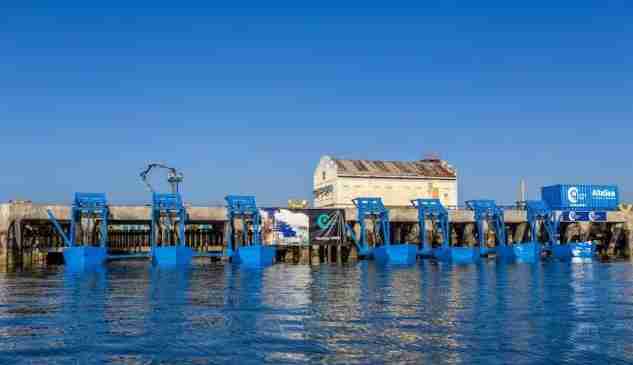
U.S. Debuts First Onshore Wave Energy Project at Port of Los Angeles, Turning Pacific Swells into Power
The United States has unveiled its first onshore wave-energy project at the Port of Los Angeles. Eco Wave Power’s AltaSea pilot converts Pacific swells into electricity, advancing Los Angeles’ 2035 clean-energy goals and demonstrating scalable marine renewables.
- Pilot installed at AltaSea demonstrating Eco Wave Power’s onshore float-to-hydraulic system.
- Pilot capacity: up to 100 kilowatts (roughly enough for about 100 homes).
- Scale potential: full breakwater deployment could reach ~60 MW — about 60,000 homes.
- Partners & funding: AltaSea collaboration with part funding from Shell; Eco Wave Power leads technology.
- Context: DOE estimates U.S. wave energy could meet roughly one-third of national electricity demand.
How the onshore wave system works
Technology and design
Eco Wave Power’s onshore design places most sensitive equipment on land for easier maintenance and reduced marine impact. The AltaSea pilot uses several blue steel floats (seven or eight) that ride wave motion. That vertical movement pushes a cylinder, forcing biodegradable hydraulic fluid through pipes into storage tanks. Stored pressure drives a motor that turns a generator to produce electricity.
Key engineering points: components sit onshore (avoiding seabed anchors), the system uses non-toxic biodegradable hydraulic fluid, and the design emphasizes simplicity and lower environmental impact.
Why onshore matters
Onshore placement reduces maintenance costs and risks tied to deep-sea operations, lowers seabed disturbance, and makes storm repairs and monitoring more practical. These traits make the approach attractive for busy port facilities pursuing renewable pilots.
Pilot scope, numbers and future plans
What the pilot will show
The AltaSea demonstration unit (up to 100 kW) is designed to test real-world performance and gather data on reliability, economics and environmental safety. While not large enough to power a neighborhood, the pilot aims to validate the concept prior to larger proposals.
From pilot to potential scale
Developers estimate that a full deployment along the Port of Los Angeles’s roughly eight-mile breakwater could reach about 60 megawatts, potentially powering around 60,000 homes. That projection requires sustained funding, permitting, engineering and consistent wave conditions along the breakwater.
Environmental and strategic importance
Clean-power goals and local air quality
Los Angeles aims for 100% clean energy by 2035 and California targets carbon neutrality by 2045. Wave power can complement solar and wind by offering a more consistent offshore resource that may help stabilize the grid and reduce reliance on fossil fuels near ports.
Port communities, which have historically borne pollution from shipping and cargo operations, could benefit from on-port renewable generation that uses existing infrastructure without heavy on-water installations.
Environmental safeguards
Designers emphasize minimal marine impact by keeping heavy equipment onshore and avoiding seabed anchors. The system’s use of biodegradable hydraulic fluid addresses spill concerns associated with conventional, oil-based fluids.
Funding, partners and international context
Who’s backing it
The pilot was developed by Eco Wave Power with AltaSea, a nonprofit ocean institute that hosts climate-focused projects. The project received part funding from Shell, indicating private-sector interest in marine renewables. Eco Wave Power has trialed similar systems internationally, including reported activity in Taiwan, India and Portugal.
Experts and leadership
“We’re starting here in LA, but we hope, aspire and believe that we will be in the United States and in other locations around the world.” — Inna Braverman, co-founder and CEO, Eco Wave Power
Project leaders frame the Los Angeles pilot as a domestic proof-of-concept that could unlock broader U.S. opportunities if it proves reliable and cost-effective. The Department of Energy’s broader estimates — that U.S. waves could supply roughly one-third of the nation’s electricity — add strategic context.
Sources and verification
This report draws on local and national coverage, project briefings and a company video demonstration. Key sources include:
- CBS Los Angeles
- Los Angeles Times
- iHeart KFIA report
- Eco Wave Power video and remarks
- Eco Wave Power press materials
Implications for Sonoma, California
Economic impact
While Sonoma County will not host this installation, local businesses — clean-energy suppliers, marine contractors and electrical firms — could benefit if Eco Wave Power or similar companies expand U.S. operations. A scaled Port of Los Angeles deployment would create supply-chain demand across California.
Political and policy consequences
For Sonoma’s moderate electorate and local officials, the pilot showcases how renewables can be sited in industrial port areas without occupying coastal land or harming beaches. That demonstration may ease political resistance and encourage support for state-level incentives or pilot programs with low visual impact and strong environmental protections.
Social and public health effects
Sonoma residents concerned about air quality may view the Port of Los Angeles project as a positive example of reducing fossil-fuel reliance near emission-heavy facilities. Statewide emissions reductions could yield air-quality improvements that benefit all regions, including Sonoma.
Cultural relevance
Sonoma communities value preserving coastal and natural landscapes. The onshore approach — keeping heavy equipment on land and avoiding seabed disturbance — aligns with regional preferences for low-impact renewable solutions and may be more acceptable to voters and environmental groups.
Practical applications for Sonoma residents
- Renewable-grid lessons: Sonoma energy planners could analyze AltaSea’s data to explore wave energy as a complement to local solar and wind.
- Local businesses: Marine service companies, electricians and environmental consultants could compete for future contracts if wave energy grows statewide.
- Community engagement: Sonoma cities and the county can emulate the pilot’s focus on monitoring and low environmental footprint when designing outreach and permitting for new renewables.
Read more
- CBS Los Angeles
- Los Angeles Times
- iHeart KFIA
- Eco Wave Power video and remarks
- Eco Wave Power press release
Reporting will continue as AltaSea’s AltaSea installation data becomes available and as officials weigh expansion, permitting and funding decisions.