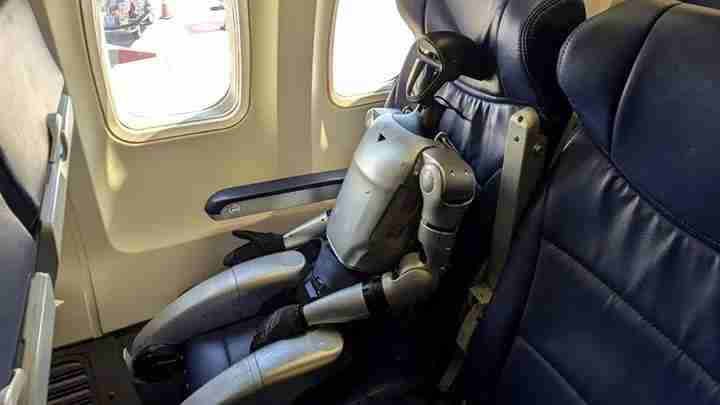
Oakland, California (Sonoma Times) – Humanoid Machine’s Attempt to Fly as a “Passenger” Sparks Safety Debate and Renewed Questions About Airline Rules
A Southwest Airlines flight departing from Oakland for San Diego was delayed for nearly an hour after airline personnel discovered that a humanoid robot traveling as a ticketed “passenger” carried a lithium battery exceeding federal airline safety limits. The unusual incident, involving a 75-pound entertainment robot named Bebop, has reignited debate over airline safety standards, the growing presence of artificial intelligence in public life, and whether machines should ever be treated like human travelers.
Top Areas Covered in This Article
- Airline safety and lithium battery regulations
- Rise of humanoid robots in commercial entertainment
- Southwest Airlines response and federal compliance issues
- Public reaction to robots traveling as passengers
- Historical concerns surrounding lithium battery fires on aircraft
- The expanding role of AI and robotics in everyday American life
The incident unfolded aboard Southwest Flight 1568 on April 30 after a robotics company attempted to transport “Bebop,” a humanoid entertainment robot, from Oakland to San Diego. The robot, which weighs approximately 75 pounds, had reportedly attracted attention at the gate by dancing and interacting with travelers before boarding.
Problems began when airline personnel determined the robot and its carrying equipment exceeded Southwest’s standard carry-on weight restrictions. Company representatives then purchased an additional seat for the machine, classifying it as an inanimate object occupying a passenger seat.
However, after boarding procedures began, airline staff identified a more serious issue: the robot’s lithium battery exceeded allowable airline limits.
Southwest Airlines ultimately required the battery to be removed before the aircraft could depart, resulting in an approximate one-hour delay. The airline later confirmed the incident, emphasizing that safety procedures involving lithium battery restrictions were properly followed.
The episode has drawn national attention not only because of the bizarre image of a humanoid robot seated on a passenger jet, but also because it highlights growing tensions between rapidly advancing technology and long-established public safety regulations.
Lithium Battery Risks Have Troubled Airlines for Years
Federal aviation authorities have imposed increasingly strict lithium battery regulations over the past two decades due to the risk of onboard fires. Lithium-ion batteries, commonly found in electronics, electric vehicles, and robotics equipment, have been linked to several dangerous in-flight incidents worldwide.
The Transportation Security Administration (TSA) and Federal Aviation Administration (FAA) maintain strict limitations on battery size, storage, and transport methods because damaged or overheated lithium batteries can ignite with extreme intensity and are difficult to extinguish at high altitude.
Several cargo aircraft accidents in past years have also been connected to lithium battery fires, prompting regulators to tighten restrictions on commercial flights.
Airlines today routinely monitor battery sizes for electric wheelchairs, mobility devices, industrial equipment, drones, and oversized electronics. The incident involving Bebop demonstrates how newer forms of robotics are beginning to test existing aviation policies in unexpected ways.
Growing Presence of Robots Raises New Questions
The company behind the robot, Elite Event Robotics, specializes in renting interactive robots for trade shows, corporate events, and public entertainment. Such machines have become increasingly common at conventions, sports arenas, technology expos, and retail promotions.
But the Oakland incident raised broader public concerns about whether humanoid machines belong in passenger cabins at all.
Critics online argued that the robot should have been shipped as freight cargo rather than treated similarly to a human traveler. Others questioned whether airlines are fully prepared for the increasing transport of sophisticated robotics equipment as AI technology expands nationwide.
The debate comes amid accelerating investment in robotics and artificial intelligence across the United States. Tech firms continue pushing humanoid robots into public-facing roles ranging from hospitality and customer service to security and warehouse operations.
California, already home to many of the nation’s leading AI and robotics firms, has seen a rapid increase in robotic demonstrations at public venues, airports, and commercial events.
Southwest Stands by Safety Decision
Southwest Airlines defended its handling of the matter, stating that safety remains the airline’s top priority and that its flight crews acted professionally under existing federal regulations.
After removal of the oversized battery, the robot ultimately completed its journey to San Diego. The battery itself reportedly had to be separately transported through a complicated overnight delivery process in order to reunite with the robot at another event in Chicago later that weekend.
Despite the delay, the robotics company later celebrated the incident on social media, portraying the robot as a crowd attraction wherever it appears.
Still, the unusual situation has become another example of how emerging technologies are increasingly colliding with rules and systems built for a more traditional era — and many Americans are now asking whether regulators, airlines, and the public are truly prepared for what comes next.